
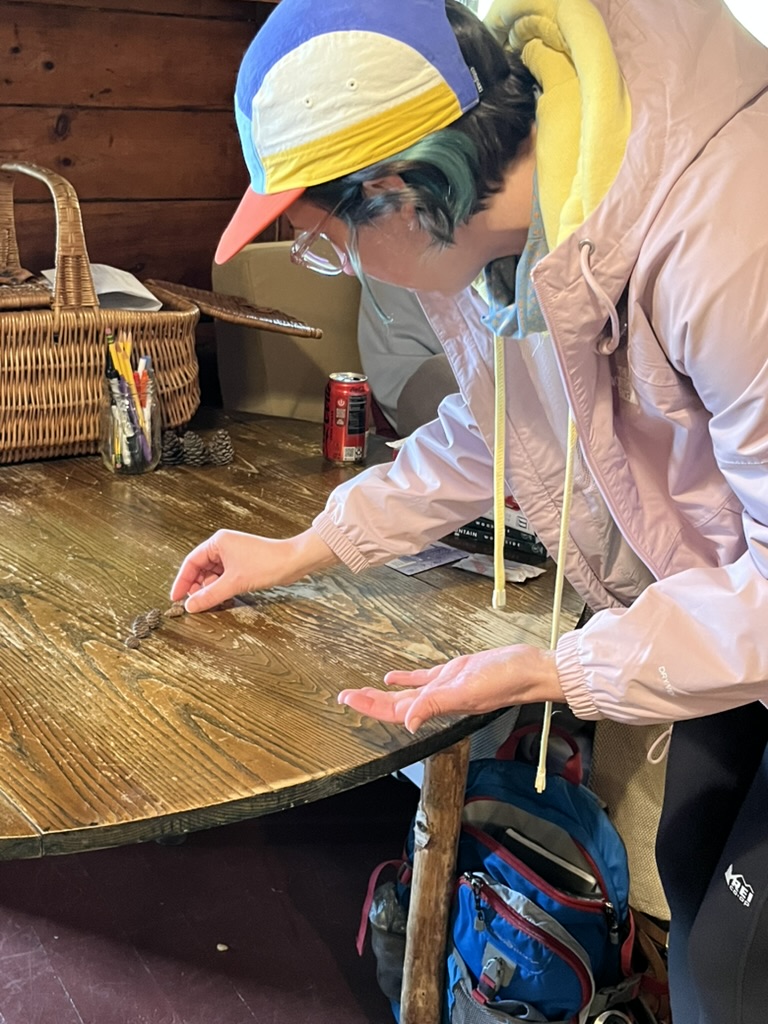
I got home a few days ago from leading my writing workshop at Rockywold-Deephaven Camps on New Hampshire’s Squam Lake. Writers walked alone, observed, wrote many words clustered around a warm fire, talked about building creative practices, dug into the history you can see and that you can’t see. We played around with the Japanese postcard art of etegami. We tried composing on an old manual typewriter. We read work out loud. Some of them talked privately with me about pages they’d asked me to review. Others worked out their creative goals for the coming year. We practice the Anne Lamott method of jotting a few words on an index card while riding in the camp boat.
We saw loons, herons, song birds, woodpeckers, mallards, and more. We visited the ice house where blocks of lake ice are stored in sawdust, a nineteenth-century practice the camp still does.
Our group spanned generations, genres, and approaches. Wherever they happen to be in their writing practices, this workshop embraced them and built it.
I think the most powerful of our writing sessions came on Sunday morning, when I asked them to write about something they had discarded, thrown away, recently.
I even solved some of my own writing questions this weekend. I have a new idea about my New Jersey book project, thanks to talking with several of you.
Thank you, 2026 writers, for sharing your work and yourselves with me.
